
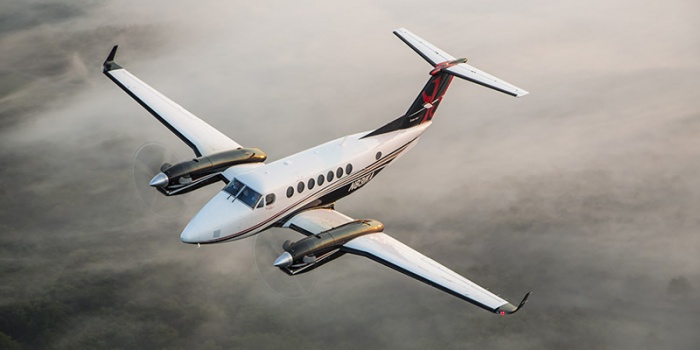
The Beechcraft King Air 350i is an upgraded version of the King Air 350, the largest model in the King Air family of twin-turboprop aircraft. Beechcraft announced the 350i in October 2008 with a redesigned passenger cabin. The newest version, the King Air 360, followed in 2020.
Charter clients choose the King Air 350 for short regional trips. It costs less per hour than a light jet, uses shorter runways, and seats 8 to 9 passengers in a typical layout. For smaller groups, see our King Air 250 private charter page.
Charter a King Air 350i Turboprop:
How Much Does It Cost to Charter a King Air 350i per Hour?
Chartering a King Air 350 or 350i costs from $2,500 per flight hour. The total depends mostly on how many hours the aircraft flies. That includes the flight to your departure airport if the aircraft is based elsewhere. A one-way price may also cover the empty flight back. Airport and landing fees are added, and crew waiting time or an overnight stay costs extra. Prices are higher on busy dates and holidays.
The 7.5% Federal Excise Tax applies to domestic US flights. International trips, such as Miami to Nassau, don’t pay this tax, but they can include customs and airport fees in the other country. Use our private jet charter cost estimator for a rough figure, or contact our team for an exact quote.
Popular Routes on King Air 350i
The King Air 350i fits best on short regional trips and private flights to airports with shorter runways. Here are typical routes with estimated flight times and prices:
| Route | Distance (nm) | Est. Flight Time | Est. Private Charter Cost |
| Denver (APA) to Aspen (ASE) | 96 | 50m | $6,500 – $10,500 |
| Miami (OPF) to Nassau (NAS) | 161 | 1h 5m | $9,000 – $12,500 |
| New York (TEB) to Nantucket (ACK) | 183 | 1h 10m | $7,500 – $10,500 |
| Los Angeles (VNY) to Las Vegas (LAS) | 199 | 1h 15m | $8,000 – $11,000 |
| Houston (HOU) to Dallas (DAL) | 208 | 1h 15m | $9,500 – $13,000 |
The King Air 350i can also fly longer trips, such as Chicago to Denver in about 3 hours 20 minutes, but a jet is faster on routes of that length.
King Air 350i Overview
The King Air 350i has two Pratt & Whitney Canada PT6A-60A engines, each rated at 1,050 shaft horsepower. It cruises at up to 312 knots and flies as high as 35,000 ft. The cockpit uses Collins Pro Line avionics, and later aircraft have the touchscreen Pro Line Fusion system.
The King Air family has been in production since the 1960s, and thousands of these aircraft fly around the world. Operators value the 350i for its reliability.
King Air 350 vs. King Air 350i
The King Air 350i is an updated King Air 350. The two differ in age, cockpit, and cabin technology. They share the same engines, speed, range, and cabin size.
| King Air 350 | King Air 350i | |
| In service | Since the early 1990s | Since 2009 |
| Avionics | Collins Pro Line II; Pro Line 21 from 2004 | Pro Line 21; later aircraft have Pro Line Fusion touchscreens |
| Cabin technology | Varies by aircraft | Collins Venue cabin management system and a quieter cabin |
| Classification | Turboprop | |
| Engines | 2 × Pratt & Whitney Canada PT6A-60A, 1,050 shp each | |
| Max cruise speed | 312 ktas | |
| Max range | 1,806 nm | |
| Max altitude | 35,000 ft | |
| Seats | Up to 11 (8–9 in a typical layout) | |
| Cabin (H × W × L) | 4 ft 9 in × 4 ft 6 in × 19 ft 6 in | |
| Baggage capacity | 71 cu ft | |
| Lavatory | Yes | |
Flight times and private charter prices are about the same for both. In most cases, the choice depends on which aircraft is available for your dates.
King Air 350i Interior
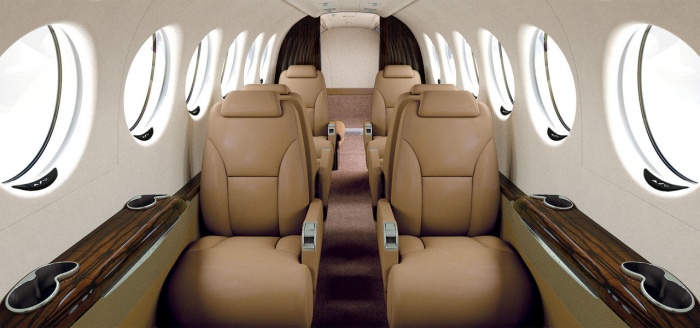
Beechcraft had restyled the cabin chairs with recessed headrests, retractable armrests, with inboard and outboard tracking. The cabin overhead has indirect lighting that glows softly. And cabin furniture has also been upgraded with a large hot and cold beverage unit as well as cabinets built into the seat backs.
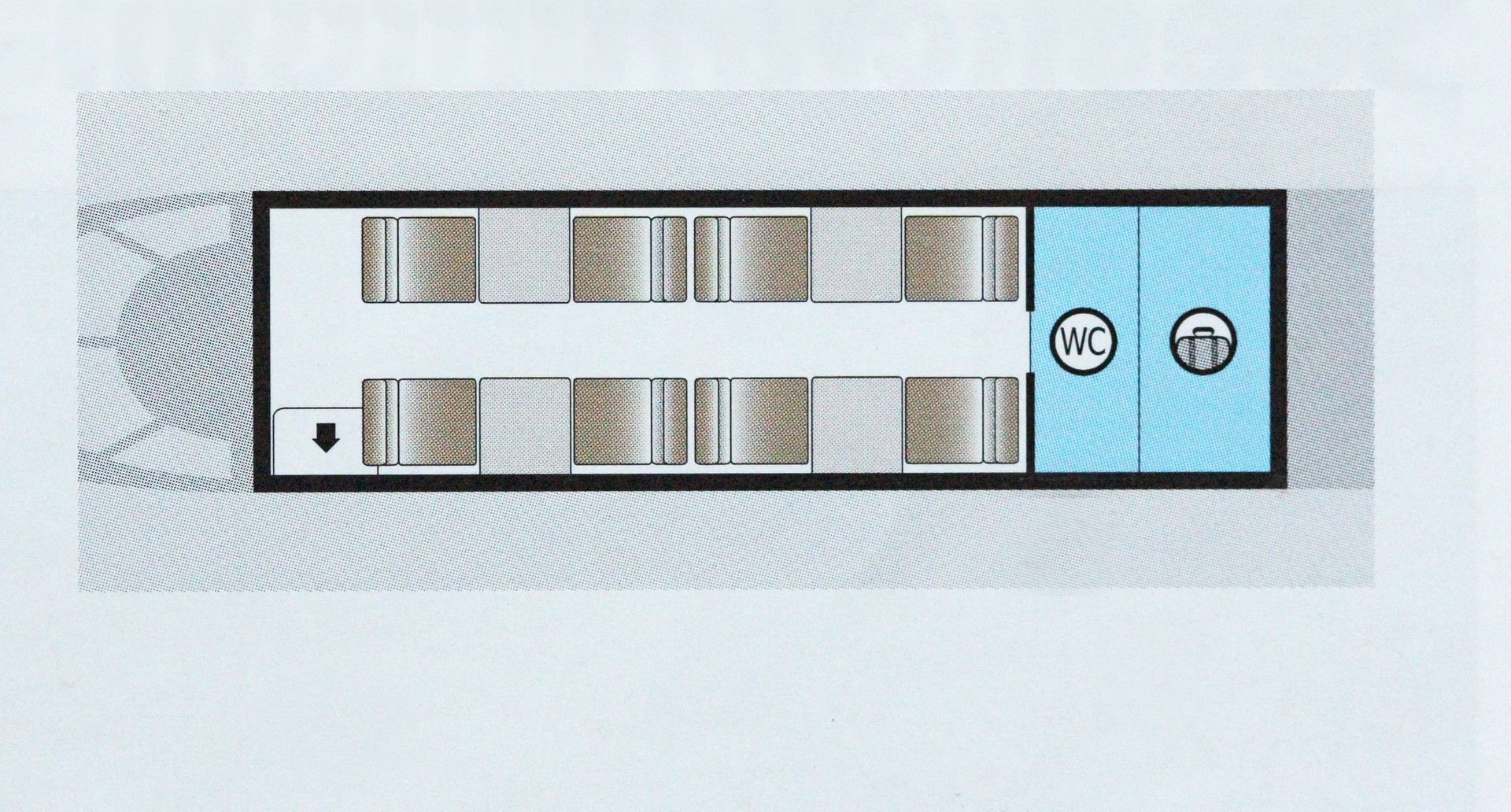
The pressurized cabin usually has four club seats facing each other in the front section, with more seats behind them. The back of the cabin has a lavatory and a baggage area you can reach during the flight. The 350i also introduced the Collins Venue cabin management system, which lets passengers control lighting, temperature, and entertainment from their seats.
Book a King Air 350 or 350i Charter with Monarch Air Group
Our clients travel on efficient and comfortable private jets. If you haven’t found the answers to all your questions, you can contact our experienced and reliable team at any time or visit our air charter FAQ page.
For charter rates and availability of the King Air 350i, please submit the below flight request form, or call our agents 24/7 at 1-877-281-3051.
FAQs: King Air 350 & 350i Private Flights
How far can the King Air 350i fly?
The King Air 350i can fly up to 1,806 nm. Most charters use it for trips of under two hours, where its top speed of 312 knots matters less than its lower cost and shorter runway needs. On longer trips, a light or midsize jet is faster.
What runway length is required for the King Air 350i?
The King Air 350i needs about 3,300 ft of runway for takeoff and about 2,480 ft for landing. That lets it use many small airports that larger jets cannot reach.
What are the cabin amenities of the King Air 350i aircraft?
Passengers flying privately on the King Air 350i will be pleasantly surprised by the cabin’s spaciousness, which is larger than in many light jets. There are retractable work tables between each pair of seats for productive work in the air, and an active noise cancellation system reduces in-flight noise, which helps you relax completely. If you need expert help finding the best private King Air 350i, contact our charter experts at your convenience.
Can a King Air 350 cross the Atlantic?
Not nonstop. With a range of about 1,800 nm, an Atlantic crossing needs several fuel stops. A long-range jet is the better choice for a transatlantic trip.
Does the King Air 350 have a toilet?
Yes. The King Air 350 has a lavatory at the back of the cabin.
Should I charter a King Air 350/350i or a light jet?
Choose the King Air 350 or 350i for short trips, small airports, or a group of 8 to 9 with luggage. It costs less per hour and needs less runway. Choose a light jet when speed matters more, especially on trips longer than about two hours.

 Tags: